A History of Meat-Eating - Part 3: Industrial Agriculture
posted on
March 1, 2026

If you've been following along, you've probably noticed this one took me a bit longer to write.
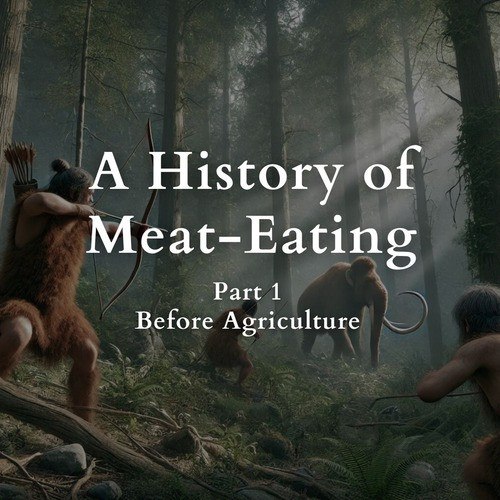
In Part 1, we looked at the evolutionary origins of meat-eating among humans beginning 7 million years ago. It was truly fascinating, species-defining stuff. Dr. Briana Pobiner of the Smithsonian's Human Origins Program was kind enough to review the post and provide guidance along the way.
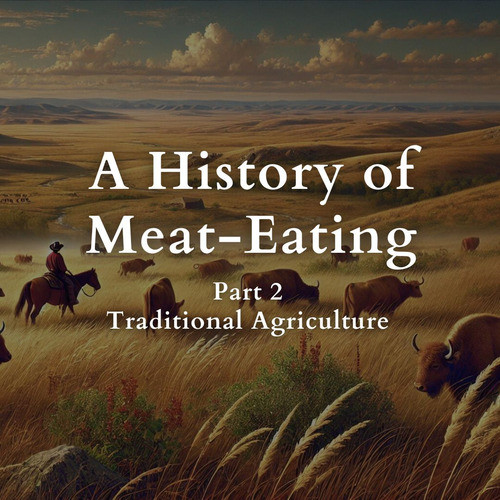
In Part 2, we saw the world change dramatically as humanity began to transform entire ecosystems to suit its needs. We saw how agriculture allowed human populations to soar 400x from just 5 million to over 2 billion.
In this third and final part, we're taking a close look at just the last 100 years of human history. As we're about to see, human civilization, natural landscapes, and our relationship to our food have changed more during this period than at anytime before.
Let's begin...
PRELIMINARY NOTES:
- I've chosen not to rigorously cite sources as I did in the first two parts, given the modern historical information contained here is readily available and generally not disputed.
- All images are AI-generated and certain artistic liberties have been taken.
1933 - The battery cage era begins

The modern battery cage for laying hens was introduced and would go on to dominate U.S. egg production for decades.
Around the same time, debeaking, or beak trimming, was adopted to reduce injury and cannibalism in densely confined flocks.
After the discovery of Vitamin D in the 1920s, producers began adding it to poultry feed. This made it possible to raise hens entirely indoors without access to sunlight.
1934 - The supermarket changes everything

The first supermarket opened. Prior to this, meat was largely purchased directly from butcher shops or farms.
National and global supply chains began to replace local supply chains.
1947 - Antibiotics reshape animal agriculture

Antibiotic use was widely adopted in animal agriculture in the US. This made it possible to raise larger numbers of animals in confined indoor settings without them succumbing to disease.
1950 - The "Chicken of Tomorrow"

The “Chicken of Tomorrow” competition was introduced to incentivize American farmers to breed faster growing broiler chickens for indoor production.
Until this time, chickens raised for egg production and those raised for meat were the same breeds. But with the beginning of selective breeding, chickens bred for meat production began growing faster, to a larger size, and with larger breasts.
While raising a 3 pound chicken used to take 16 weeks, over time a 5 pound chicken would be possible in under half the time (less than 8 weeks.) This drastically brought down the relative cost of chicken meat, contributing to it eventually becoming the most consumed protein in the U.S.
But these efficiency gains came with significant drops in animal welfare. Modern meat chickens, or "broilers," suffer from lethargy, organ failure, leg issues, respiratory issues, and other complications from growing so quickly.
1957 - Fast food goes national

Fast food chains began to expand.
These establishments required large amounts of meat that was both uniform and cheap.
1967 - Gestation crates introduced

Gestation crates were invented to increase production on pig farms by confining sows to a metal enclosure for 16 weeks at a time. While this led to reductions in piglet deaths, it came at the cost of reduced welfare for mother pigs.
1970 - The Green Revolution

The term “Green Revolution” was first used to describe the widespread adoption of technologies for increasing crop yields, such as frequent applications of chemical fertilizers, pesticides, herbicides, fungicides, and the utilization of high-yield crop varieties.
1974 - "Get Big or Get Out"

The U.S. Secretary of Agriculture encouraged U.S. farmers to “get big or get out” of agriculture, facilitating a massive increase in average farm size and decrease in the number of American farms. Traditional animal husbandry practices were no longer economically viable, nor were they aligned with the administration's geopolitical ambitions.
Increasingly chickens, turkeys, pigs, and cattle were removed from the American landscape and confined to Concentrated Animal Feeding Operations (CAFOs.)
1987 - 5 Billion Humans

Humans surpassed 5 billion global population, representing a 5x increase in just 183 years.
2006 - The Omnivore's Dilemma

The Omnivore's Dilemma by Michael Pollan was published, bringing the hidden structures of the modern food system into mainstream cultural awareness.
The book challenged consumers to confront the ecological, ethical, and economic consequences of industrial agriculture, helping spark renewed interest in local food, pasture-based livestock, and regenerative farming practices.
2009 - Lab-grown meat enters cultural discourse

The People for the Ethical Treatment of Animals (PETA) offered a $1 million reward to the first laboratory to create a commercially viable in vitro “chicken” product.
2013 - The first lab-grown burger

Dutch scientist Mark Post unveiled the world's first lab-grown beef burger. It was grown from cow muscle stem cells cultured in a growth medium that included fetal bovine serum, a nutrient solution derived from the blood of unborn calves.
2017 - Factory farming dominance

Virtually all meat in the U.S. was produced on factory farms. 99.97% of chickens, 99.9% of turkeys, 98% of pigs, 70% of cattle.
2018 - Resurgence of pasture-based farms

Hungry Hollow Farm began providing pasture-raised meats to the Western Washington community.
It was one of thousands of small farms around the country raising animals on pastures and selling directly to local families. Not as an act of nostalgia, but as a deliberate response to the industrial system that had come to dominate the American diet.
2019 - Imitation meat's cultural peak

Beyond Meat became the first imitation meat company to go public, trading at a high of $234.90/share.
2023 - The pig skyscraper

A 26-story “pig skyscraper” opened in China, designed to raise and slaughter 1 million pigs per year in a single building.
2024 - Lab-grown meat approved for sale

The first lab-grown meats were approved for sale by the USDA.
Beyond Meat’s share price ends 2024 at $8.90, having lost 96% of its value since its peak. (As of 3/1/26, the stock is trading at just $.95 per share.)
Humans surpassed 8 billion global population.
---
Conclusion
Of the three blog posts in this series, this one was by far the most difficult to write. The last century was an era characterized by systematized animal cruelty on an unprecedented scale. But thankfully, the news is not entirely bad:
- 55% of laying hens in the U.S. now live in battery cages, down from a high of 95% in the 1990s
- 10 states have now banned gestation crates for breeding pigs
- The number of U.S. farmers markets has quadrupled since the 1990s, signaling renewed interest in local foods
- Regenerative agriculture has moved from a fringe concept to mainstream discussion among major food brands and retailers
While there's still clearly a long way to go, the tide seems to be shifting.
We began this blog series with a list of questions about meat-eating. Based on what we’ve covered, let’s see if we can answer them:
Is meat good or bad for us?
As we’ve seen, the nutritional quality of meat is directly linked to how it was produced. Wild and pastured meats have superior nutritional profiles when compared with industrial meats. Meat has been a part of human diets for at least 2.6 million years, pre-dating the evolution of our species by 2.3 million years. For nearly all of that time meat was a scarce, high-value food rich in nutrients not easily obtainable elsewhere.
Is eating meat bad for the environment?
Again, it depends on how the meat is produced. Wild animals tend to benefit the greater ecosystem if their numbers are kept in check by predation. Pastured livestock can be a fantastic contributor to soil health if they are managed appropriately. Industrial livestock are one of the greatest contributors to global ecological degradation due to water and air pollution.
Are grass-fed and pasture-raised meats better than industrial meats?
Yes, there are numerous studies that substantiate the nutritional benefits of grass-fed and pasture-raised meats when compared to their industrial counterparts.
Will we all eat plant-based and lab-grown meats in the future?
Probably not, but some of us might.
The one thing proponents of regenerative agriculture, venture capitalists investing in lab-grown meats, executives at imitation meat companies, and animal rights activists can all agree on is the need to replace industrial animal agriculture with something better. The future of meat will almost certainly include these different avenues working in various capacities to replace the current system of industrial animal agriculture.
When did all this confusion begin?
For 96% of the existence of our species, meat meant wild animals. Each hunt was visible. Each kill fed a tribe.
For another 3.96%, meat largely meant meat from animals raised through traditional husbandry. Livestock lived alongside crops. Nearly everyone lived on or near a farm. The role of animals in sustaining soil and feeding communities was not abstract, it was daily life.
Only in the last .04% of our existence has meat become synonymous with confinement.
Most of our confusion about meat has emerged in this sliver of time, in an era in which we depend on a vast, hidden industrial system for our sustenance, while forgetting the role well-managed livestock have historically played in resilient food systems.
Where do we go from here?
Supporting your local farms that are raising animals on pastures is a great first step. These farms are regenerating farmland and reincorporating animals into the American landscape.
Crucially, be sure to buy directly from a local farm. Not from a farm on the other side of the country. Not from a venture-backed eCommerce company. And certainly not from a national grocery chain.
This localized demand for pastured meats is a necessary step in the right direction, but conscious consumerism alone will not be sufficient for wide-scale change. We also need policies that reward farmers for producing high-quality foods in ways that enhance, rather than detract, from local and regional ecosystems.
It has been said that necessity is the mother of innovation. Shifting to farming 12,000 years ago was necessary to support a growing population. In many ways, the shift 100 years ago to confined animal farming was necessary because we didn’t yet have the technology to successfully scale up traditional animal husbandry (most notably, electric fencing for predator exclusion.) As animals have now been largely removed from croplands, they’ve suffered from decades of degradation from chemical applications.
As our soils have suffered, so has our health. The reintegration of crop and livestock production is now necessary to reverse the trend of cropland degradation and to restore our health.
At the end of the day, it’s impossible to say what the future holds. But for us here at Hungry Hollow Farm, and for many other practitioners of traditional animal husbandry, one thing is certain:
For as long as we’re able, we’ll be here producing the highest quality foods in the sanest way we know. Not in concentrated feedlots, not in a lab, but in harmony with our local and global ecosystems.
Thank you for taking this 7 million year journey with us!
About Hungry Hollow
Hungry Hollow is a diversified farm in Shelton, WA producing pasture-raised meat, eggs, and vegetables. With a focus on animal welfare and ecological stewardship, our work models an alternative to industrial agriculture that is rooted in joy, transparency, and reverence for life.